



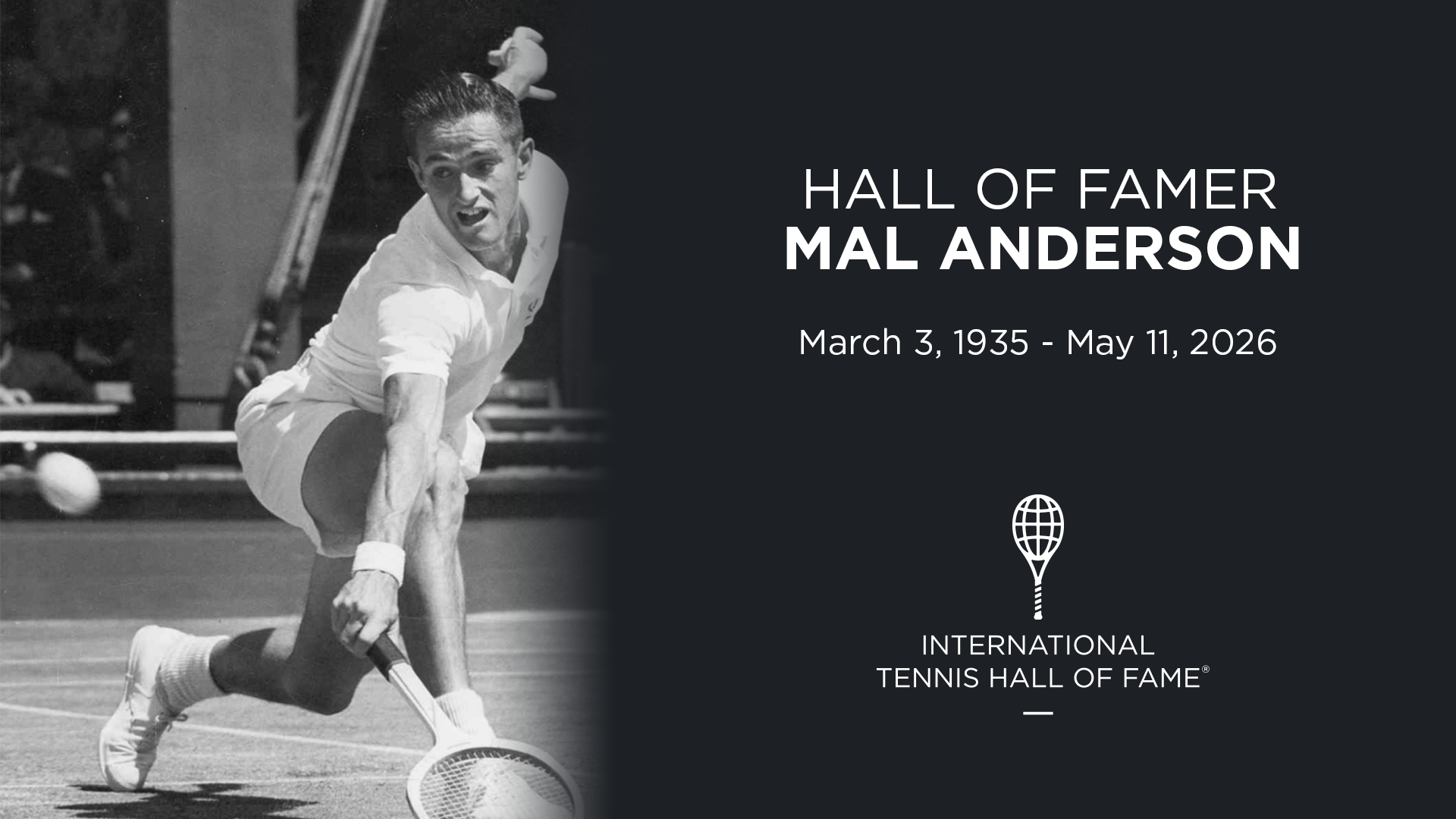
In Memoriam: Hall of Famer Mal Anderson
Written by Joel Drucker, ITHF Historian-at-Large
Mal Anderson, a silky-smooth Australian who, in 1957, became the first man to win the U.S. National (now the US Open) singles championship unseeded, died on Monday, May 11. Inducted into the International Tennis Hall of Fame in 2000, Anderson was 91 years old.
The months leading up to that historic U.S. Nationals title run were a challenging time for Anderson. There’d been a battle with heat exhaustion. At Wimbledon, Anderson broke a toe. Frustrating losses followed. In the middle of his summer struggles, Anderson received a letter from Australian Davis Cup captain Harry Hopman. Based on Anderson’s meager recent results, Hopman’s recommendation was that Anderson cancel his upcoming wedding and instead return Down Under to commence a rigorous training regimen.
Angered by Hopman’s decree, Anderson won the title in Newport that July, site of the International Tennis Hall of Fame. Arriving in New York both confident and motivated, Anderson won his first three matches without the loss of a set to reach the round of 16. There, Anderson faced second-seeded Dick Savitt in the round of 16 – and beat him handily, 6-4, 6-3, 6-1. In the semis, Anderson fought from two sets to love down to beat third-seeded Sven Davidson, 6-4 in the fifth. And on the last day, Anderson took down the top seed, his fellow Aussie and close friend, Ashley Cooper, 10-8, 7-5, 6-4. Savitt, Davidson and Cooper would all join Anderson as International Tennis Hall of Fame inductees.
“Anderson’s performance ranks within the finest displays of offensive tennis in recent years,” wrote New York Times writer Allison Danzig. “His speed of stroke and foot, the inevitability of his volley, his hair-trigger reaction and facileness on the half-volley, the rapidity of his service and passing shots and the adroitness of his return of service . . . all bore the stamp of a master of the racket.” To think that just the previous year, he’d lost in the first round in straight sets.
In the wake of that breakthrough triumph, there was no stopping Anderson’s wedding plans. On October 5, he married Daphne Emerson, sister of his close friend and fellow Aussie great, Roy Emerson. Anderson also continued to play excellent tennis. At the end of 1957, he won titles in Adelaide and Melbourne and helped Australia retain the Davis Cup, winning Challenge Round matches in both singles and doubles. The next year, Anderson won six singles titles and reached the finals at the Australian and U.S. Championships. Beginning in 1959, Anderson joined Jack Kramer’s troupe of barnstorming professionals, that first year winning a prominent tour event in London.
Anderson proved remarkably sturdy. After taking a few years off from tennis in the late ‘60s, he returned to competition in 1969 at the age of 34. Anderson went on to win five singles tournaments and reach the singles final of the 1972 Australian Open. That run Down Under was highlighted by a five-set win over world number one John Newcombe. Anderson also made a successful return to Davis Cup, playing a key role on Australia’s 1973 championship squad. All told, Anderson won 21 singles titles, as well as two majors in men’s doubles (’57 Roland-Garros, ’73 Australian) and one mixed (’57 Australian).
Malcolm James Anderson was born on March 3, 1935 in Theodore, Queensland. He grew up on a 6,000-acre cattle ranch, a background which naturally led to Anderson being nicknamed “Country.” On the Anderson ranch, a tennis court was laid out over dirt and gravel. Anderson, his parents and three brothers so enjoyed the game that in time they built a second court. A local coach, Charlie Hollis, worked with Anderson and another country lad three years younger named Rod Laver. As Anderson said about Hollis in a 2017 Tennis Queensland story, “he didn’t try to make robots out of everyone; he worked on your ability . . . I was a good server and played a more aggressive game which a lot of people did in those days – serve and volleying.”
Anderson was always highly regarded by his peers. “He was friendly and funny,” wrote Rod Laver in his book, The Golden Era. “When he became a champion, Mal was still a charmer, a natural gentleman with impeccable court manners.”
He is survived by his three children, nine grandchildren, and numerous great-grandchildren.
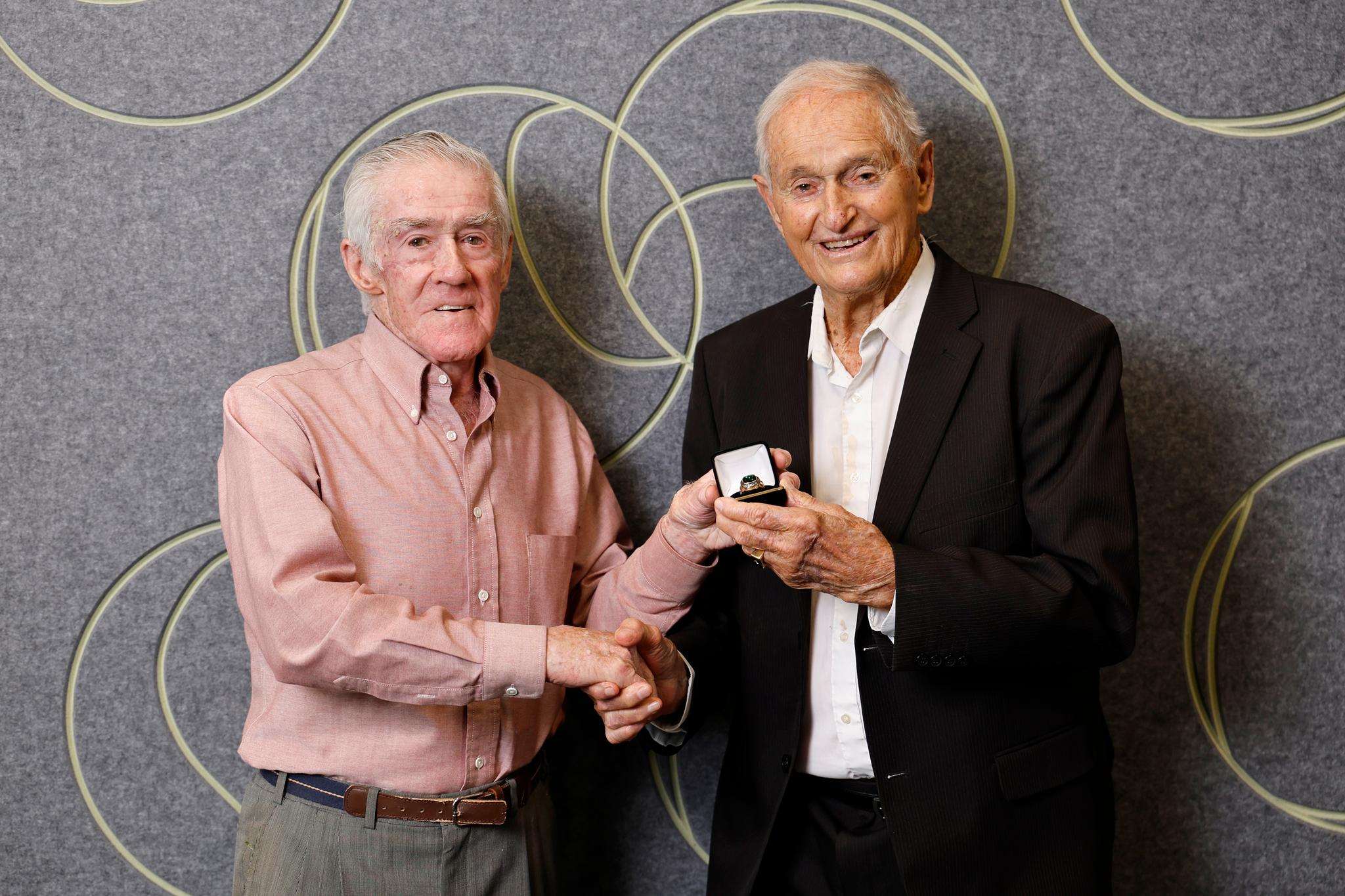
In June 2025, Hall of Famer Ken Rosewall presented Mal Anderson with his official Hall of Fame ring in a special ceremony at the Billie Jean King Cup qualifiers in Brisbane, Australia.
